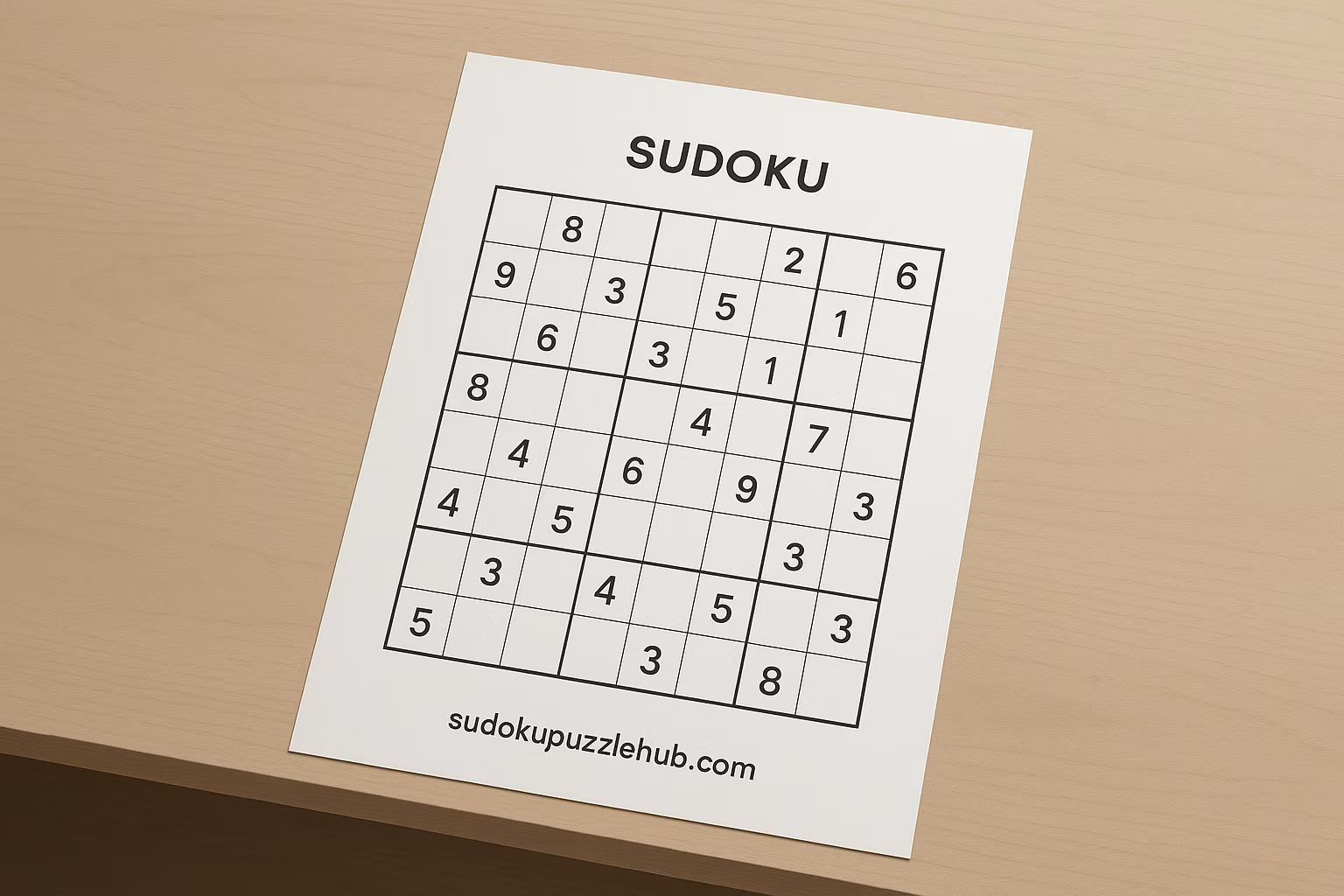

Diagonal sudoku puzzles look exactly like a normal grid until you notice two faint lines running corner to corner. That’s the whole variant in one glance: add a rule that both main diagonals must also hold the digits 1 through 9 exactly once, and the puzzle you thought you knew starts behaving differently. This guide covers what actually changes when you solve one, clears up a mix-up that trips up even experienced players, and gives you three habits that make diagonal grids click faster. You can try the rule for yourself, free, at Diagonal Sudoku while you read.
The extra rule
Start with what stays the same. Every row still needs the digits 1 to 9 with no repeats. Every column, same thing. Every 3×3 box, same thing. Diagonal sudoku, sometimes called X-Sudoku, adds one more group to that list: the nine cells running from row 1, column 1 down to row 9, column 9, and the nine cells running from row 1, column 9 down to row 9, column 1. Each of those two diagonals must also contain 1 through 9 exactly once.
Here’s the detail most players miss. Those two diagonals cross at exactly one cell: row 5, column 5, dead center of the grid. That cell belongs to its row, its column, its box, and both diagonals at once, five separate groups pulling on the same nine slots. No other cell on the board carries that much weight. When you’re stuck and don’t know where to look next, row 5, column 5 is usually where the puzzle is trying to tell you something.
Sudoku X vs the X-Wing
This is where a lot of searches go sideways, so let’s separate the two clearly. Sudoku X (X-Sudoku, diagonal sudoku) is a puzzle type. It’s a grid with the standard rules plus the diagonal constraint described above, and you either play a puzzle that has it or you don’t.
The X-Wing is something else entirely: a candidate elimination pattern used while solving classic sudoku, no diagonals involved. It shows up when a candidate digit appears in exactly two cells in each of two rows, and those cells line up in the same two columns. That rectangle lets you strike the candidate from the rest of those columns, and it works on a completely standard grid. If you came here looking for that technique specifically, our X-Wing tutorial walks through it with worked grids. If you came here because you’re playing a puzzle with an actual X drawn across it, you’re in the right place.
How solving changes
Two things shift once diagonals are in play. First, diagonal cells tend to resolve into naked singles earlier than the rest of the board, simply because they’re carrying an extra constraint that non-diagonal cells don’t have. Second, and this is the one solvers forget mid-game: a digit placed anywhere on a diagonal eliminates that digit from every other cell on that same diagonal, even cells that share no row, column, or box with it.
Say row 1, column 1 holds a 4. Row 5, column 5 sits on the same diagonal but is nowhere near row 1, column 1 in terms of row, column, or box. It still can’t be a 4. Neither can row 6, column 6, row 7, column 7, or any other cell on that diagonal, regardless of how far away they sit on the grid. Standard elimination logic would never catch that connection. Diagonal logic does.
Here’s a fuller worked example. Suppose the top-left-to-bottom-right diagonal already has 2 at row 1 column 1, 6 at row 3 column 3, 8 at row 6 column 6, and 9 at row 8 column 8. That leaves only 1, 3, 4, 5, and 7 for the remaining diagonal cells: row 2 column 2, row 4 column 4, row 5 column 5, row 7 column 7, and row 9 column 9. Now say row 7’s own row-and-box logic has already knocked out 1, 3, and 4 from row 7, column 7 through ordinary scanning. Combine that with the diagonal restriction and row 7, column 7 is down to 5 or 7, often resolving to a single answer well before its row or box alone would have gotten there. That’s the extra leverage diagonal cells give you, and it’s worth scanning for before you fall back on standard scanning. All the usual techniques still apply on top of this: naked pairs, hidden singles, locked candidates, and pattern moves like the X-Wing. Our sudoku techniques guide covers those if you need a refresher.
Three habits for diagonal puzzles
- Scan both diagonals before you scan rows and columns. They’re smaller (nine cells each) and resolve faster, so clearing them first gives you a head start on everything else.
- Whenever you place a digit on a diagonal cell, immediately cross that digit off every other cell on the same diagonal, not just the row, column, and box you’d normally check.
- Keep an eye on row 5, column 5 from the first move. Because it sits in five overlapping groups, it often narrows down faster than players expect, and missing that can cost you several turns of unnecessary guesswork.
Common mistakes
The biggest one is checking only one diagonal out of habit and forgetting the second exists. Both matter equally, and puzzles are built with both in mind.
The second is treating diagonal elimination as if it only reaches within the usual row, column, and box boundaries. It doesn’t. A diagonal placement reaches across the whole board, and skipping that check is the fastest way to miss an easy elimination that’s sitting right there.
The third is assuming every diagonal puzzle requires X-Wing style thinking, or the reverse, assuming the X-Wing technique only matters if diagonals are involved. Neither is true. They’re independent ideas that happen to share a letter.
Frequently asked questions
Is diagonal sudoku harder?
Not automatically. The extra rule adds more constraints, which usually means more early eliminations, not fewer. Once you’re used to checking diagonals alongside rows and columns, many diagonal puzzles solve about as fast as a classic grid of the same rated difficulty.
Do both diagonals always have the rule?
In a true X-Sudoku or diagonal sudoku, yes, both main diagonals carry the 1-9 constraint, not just one. A puzzle that marks only a single diagonal isn’t following the standard variant rules.
What’s the best starting point?
Check the diagonals first, especially row 5, column 5, before moving to your usual row-by-row or column-by-column scan. Diagonal cells often give up information earlier than the rest of the grid.
Is it the same as Sudoku X?
Yes. Sudoku X, X-Sudoku, and diagonal sudoku all refer to the same variant: standard rules plus both main diagonals containing 1 through 9 exactly once. It is not the same thing as the X-Wing solving technique, even though the names sound alike.
Our diagonal sudoku puzzles mark both diagonals right on the board so you’re never guessing which cells count, and every puzzle has a guaranteed unique solution under both the classic rules and the diagonal rule together. Play with notes, hints, relaxed mode, or challenge mode, all free and with no sign-up required.