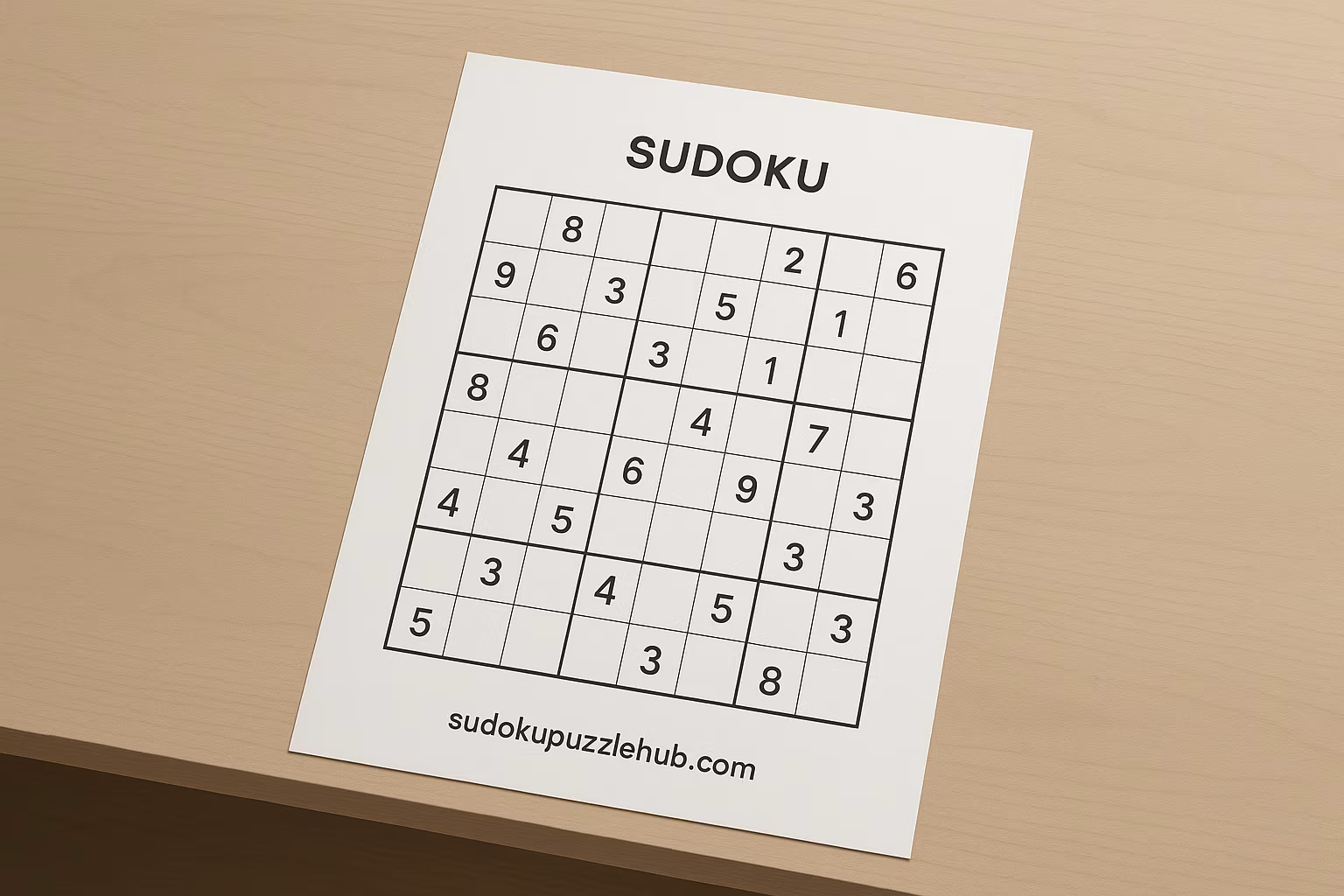

Sudoku is a number-placement puzzle played on a 9×9 grid split into nine 3×3 boxes, 81 cells in total. Fill each empty cell with a digit from 1 to 9 so no number repeats in any row, column, or box. No arithmetic involved, just logic and elimination.
Would you rather learn by doing? Skip straight to the guided puzzle, a real easy board where every move is explained as you make it. The rules and the written walkthrough are here when you want them.
If you’ve picked up a puzzle book or opened an app and stared blankly at a half-finished grid, this guide covers what you actually need: the rules, a full first solve done step by step, the handful of techniques that get beginners through most puzzles, the mistakes that trip up new solvers, and a 30-day plan for building the habit. You can also play free Sudoku puzzles right here while you read, so open one in another tab and follow along.
Sudoku Rules
Every Sudoku grid is 9 rows by 9 columns, divided into nine 3×3 boxes. That’s the whole board: 81 cells, some already filled in with clues, the rest waiting for you. The rules that govern where a number can go fit on an index card.
- Each row (all 9 cells running left to right) must contain the digits 1 through 9, with no repeats.
- Each column (all 9 cells running top to bottom) must contain the digits 1 through 9, with no repeats.
- Each of the nine 3×3 boxes must contain the digits 1 through 9, with no repeats.
That’s the whole game. All three rules are really the same rule, no repeated digit in a set of 9 cells, applied to three different kinds of set. A finished grid satisfies all three at once. Mathematicians Bertram Felgenhauer and Frazer Jarvis calculated in 2005 that there are exactly 6,670,903,752,021,072,936,960 valid completed grids, a useful reminder that simple rules can still produce an enormous puzzle space.
If you would rather see the rules than read them, the guided puzzle below starts by highlighting a row, a column and a box on a real board. For a one-page version with diagrams, plus the rules for killer, diagonal and the other variants, see Sudoku rules. Every technique mentioned on this page also has its own lesson on the technique lessons page.
How to Solve Your First Sudoku Puzzle, Step by Step
The fastest way to learn is to solve one. The board below is a real easy puzzle. The first eight moves are pointed out and explained, then you find the rest yourself with a hint one tap away. Most people finish in ten to fifteen minutes, and your progress is saved if you leave.
If you would rather read how a first solve goes before trying it, the rest of this section walks through the same ideas in words.
Every published puzzle starts with some cells already filled in. Those starting numbers are called clues, or givens, and how many you get tells you roughly how hard the puzzle will be.
| Difficulty | Typical clue count |
|---|---|
| Easy | 40 or more |
| Medium | 33 to 39 |
| Hard | 28 to 32 |
| Expert | 23 to 27 |
No properly constructed puzzle goes below 17 clues. That floor isn’t a design convention, it’s a mathematical fact: researchers Gary McGuire, Bastian Tugemann, and Gilles Civario proved in 2012, after an exhaustive computer search, that no 16-clue puzzle can have a unique solution. Below 17 clues, a grid either has more than one solution or none at all.
Start with an easy puzzle. If a 9×9 grid still feels like a lot to track, try a 6×6 mini Sudoku first. Same three rules, smaller grid, fewer places for your eye to lose track while you build the habit of scanning.
- Scan the whole grid first. Rows, columns, or boxes that are almost full give up their missing digit fastest.
- Pick a number, say 5, and check each box in turn for where a 5 could legally go given the 5s already placed in that box’s rows and columns. This is cross-hatching, covered in more detail below.
- When a cell has only one possible digit left, once you’ve ruled out everything else in its row, column, and box, write it in. That’s a single, and it’s the most common way beginners make real progress.
- After placing a number, recheck the row, column, and box it belongs to. One placement often opens up the next one nearby.
- When you run out of obvious placements, switch to a different number or a different part of the grid instead of staring at the same three cells.
- Keep going in passes. A typical easy puzzle takes 10 to 20 minutes once the pattern clicks, and each full solve makes the next one faster.
Beginner Techniques That Solve Most Puzzles
Advanced strategy isn’t needed to finish easy and medium Sudoku. Four techniques, used together, get most solvers through puzzles rated easy through medium without much trouble.
Scanning
Scanning means running your eye across a row, then down a column, then around a box, checking which digits are already placed and which are missing. It sounds obvious, but most beginners scan too fast and miss a digit that was sitting there the whole time. Slow down for your first two or three passes on a new grid.
Cross-Hatching
Cross-hatching narrows down where a single digit can go inside one box. Pick a number, then trace, mentally or with a pencil, the rows and columns that already contain that number. Any cell those lines cross is eliminated. Whatever’s left in the box is where that number has to go, sometimes right away, sometimes after cross-hatching a few more numbers in the same box.
Pencil Marks
Pencil marks are the small candidate numbers written in the corner of a cell, listing every digit that could still legally go there. Once a cell has only one pencil mark left, it’s solved. Beginners often skip pencil marks because writing 3 or 4 tiny numbers in a cell feels slow, but on medium puzzles and harder it saves far more time than it costs. If you’re working from paper, printable puzzle sheets with extra margin space make pencil marks easier to keep tidy.
Singles
A single is any cell where only one digit is possible, whether you found it by scanning a nearly complete row or by narrowing pencil marks down to one candidate. Hunting for singles after every placement is the core loop of solving: place a number, recheck the affected row, column, and box, find the next single, repeat.
Once these four are second nature, the next step up is pointing pairs, naked pairs, and eventually X-Wing, all covered in the Sudoku solving techniques guide. Save that guide for once easy and medium puzzles stop giving you trouble.
Each of these has a step-through example on its own page: scanning, naked singles, hidden singles and pencil marks.
Common Beginner Mistakes
A handful of habits account for most of the wrong turns new solvers make.
- Writing a number before checking all three units. A digit might be fine for its row and column and still repeat inside its 3×3 box. Check all three before committing.
- Forgetting to update pencil marks. Every time you place a number, that digit needs to disappear from the candidate lists of every cell sharing its row, column, and box. Skipping this step causes errors that surface much later, when they’re harder to trace back.
- Guessing when stuck. A properly made puzzle never requires a guess. If nothing seems to move, go back to scanning rather than picking a number and hoping.
- Rushing past easy puzzles. Scanning and singles need to become automatic before intermediate techniques are worth learning. Solving a stack of easy puzzles quickly is not wasted time.
- Not rechecking after a mistake. If several cells stall with zero valid candidates, a number was placed wrong somewhere upstream. Trace back rather than pushing forward.
A 30-Day Practice Plan
Sudoku improves fastest with short, regular sessions rather than occasional long ones. This plan breaks a month of practice into four stages, each building on the last.
Week 1: Easy puzzles only
Solve easy puzzles daily, 15 to 20 minutes a session. The goal isn’t speed, it’s turning scanning and singles into reflex and getting comfortable keeping pencil marks organized. The daily Sudoku puzzle is a good fit here, since it gives you a fixed, low-pressure target each day.
Week 2: Move to medium
Once easy puzzles take under 10 minutes consistently, shift to medium. Start looking for pointing pairs, where a candidate in a box is restricted to one row or column, and naked pairs, two cells in a unit sharing the same two candidates.
Week 3: Add fish patterns
Medium puzzles should feel manageable most days by now. Introduce X-Wing and other fish patterns for the puzzles that still stall. These are covered step by step in the solving techniques guide linked above, and they rarely click on the first attempt, so don’t expect instant results.
Week 4: Mix difficulties and time yourself
Rotate between easy, medium, and hard puzzles in the same session. Time a few solves to see how far you’ve come since week 1, and jot down whatever move caused you to get stuck. A short list of your own sticking points is worth more than generic advice. By the end of the month, most solvers are ready to try hard Sudoku puzzles as a regular part of the rotation. If you want variety rather than raw difficulty, variants like Diagonal Sudoku and Jigsaw Sudoku change one rule at a time while keeping every technique you have practiced.
Frequently Asked Questions
Is Sudoku a math game or a logic game?
It’s a logic game. The digits 1 through 9 are just distinct symbols, nothing is added, subtracted, or calculated. You could swap them for nine letters or colors and the puzzle would play exactly the same.
What’s the easiest way to start a Sudoku puzzle?
Scan the grid for rows, columns, or boxes that are nearly full, then look for the one digit missing from each. Those give you your first few placements without any real technique needed.
Do all Sudoku puzzles have exactly one solution?
Yes, in a properly constructed puzzle. Puzzle setters check every published grid to confirm it has one, and only one, valid solution reachable through logic alone.
Is guessing ever necessary in Sudoku?
No. A well-made puzzle can always be solved through deduction. If you feel like you have to guess, it usually means there’s a technique or a pencil mark you haven’t applied yet, not that the puzzle demands luck.
Should beginners use pencil marks?
Yes, at least in the corners of cells with more than one candidate. It feels slower at first, but it prevents the kind of small oversight that causes a puzzle to stall twenty minutes in.
Why do I get stuck even on easy puzzles?
Almost always because a scan was rushed. Easy puzzles are designed to yield to singles and cross-hatching alone, so a stall usually means a digit was overlooked in one row, column, or box, not that the puzzle needs a harder technique.
How long does it take to get good at Sudoku?
With 20 to 30 minutes of daily practice, most people notice a real jump in speed and confidence within 2 to 4 weeks, which lines up with the practice plan above.
What’s the best way to learn advanced techniques after the basics?
Move on to one technique at a time, starting with pointing pairs, then naked pairs, then X-Wing, rather than trying to learn several at once. The solving techniques guide walks through them in that order with worked examples.