
These three sets do the lesson prep for you. Each one is a fixed PDF, already checked and laid out, sized to a grade band rather than left as one generic difficulty. Print a master copy once, run off as many sheets as your class needs, and keep the answer key for yourself.
Every sheet has a Name and Date line under the header, so a stack straight out of the printer is already worksheet ready, no extra formatting required.
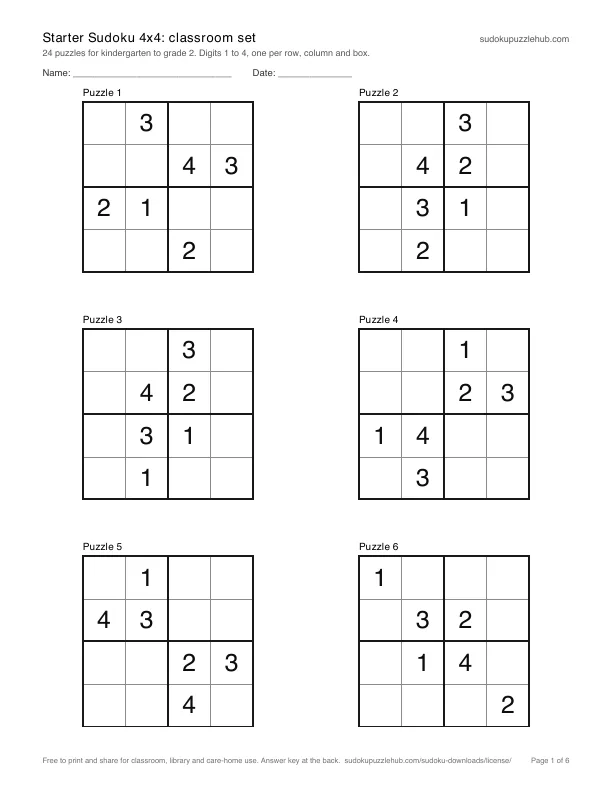
Starter Sudoku 4x4: classroom set
24 puzzles for kindergarten to grade 2. Digits 1 to 4, one per row, column and box.
Free to print and share for classroom, library and care-home use. Read the one-paragraph licence.
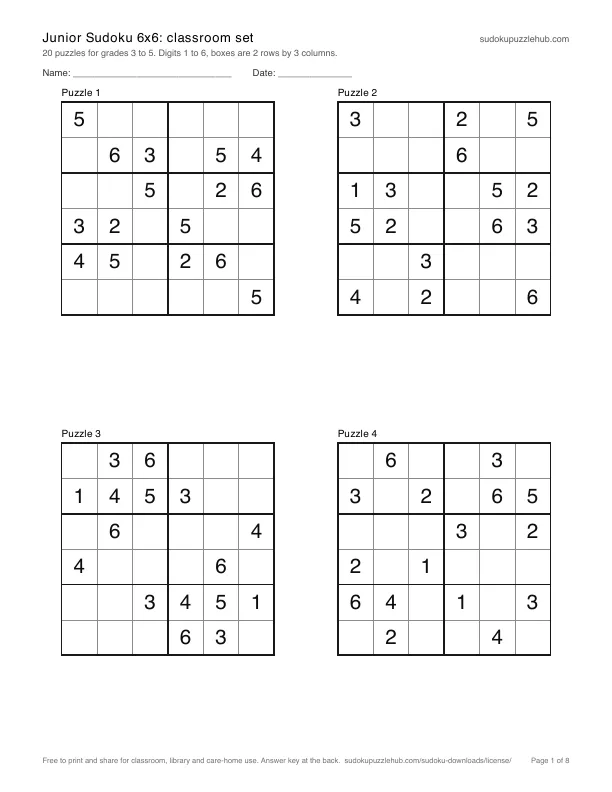
Junior Sudoku 6x6: classroom set
20 puzzles for grades 3 to 5. Digits 1 to 6, boxes are 2 rows by 3 columns.
Free to print and share for classroom, library and care-home use. Read the one-paragraph licence.
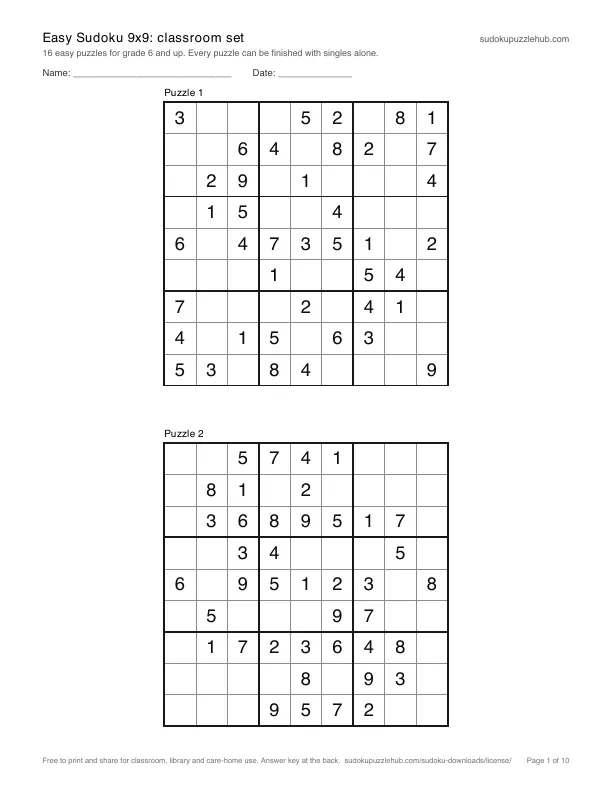
Easy Sudoku 9x9: classroom set
16 easy puzzles for grade 6 and up. Every puzzle can be finished with singles alone.
Free to print and share for classroom, library and care-home use. Read the one-paragraph licence.
Which set for which grade
The 4x4 set suits kindergarten through grade 2. It uses only the digits 1 to 4, and most children finish one puzzle in about five minutes, short enough to hold attention at that age.
The 6x6 set is built for grades 3 to 5. The boxes are 2 rows by 3 columns rather than square, which is the one new idea most children find odd at first, even though the underlying rule has not changed.
The 9x9 easy set fits grade 6 and up. It uses the full rules on the traditional grid, with enough given digits that every puzzle can be finished using singles alone.
Using them in class
These work well as starter activities, early-finisher work, or a self-checking station once the answer key is available. Print the key once and keep it at your desk rather than handing it out with every sheet.
The footer licence line on every page means photocopying for your own classroom is fine, no separate permission needed. The Name and Date line exists so a stack of finished sheets can be collected and handed back without you having to write names on them yourself.
What Sudoku practises
We keep this claim narrow, because that is what the evidence supports. Solving a Sudoku grid calls on attention to a set of fixed constraints (no repeat in a row, column or box), the habit of checking your own work before writing a digit in, and working memory, holding a short list of candidates in mind while you compare them against the grid. Those are useful classroom skills on their own, without needing a bigger claim about brain training attached to them.
Frequently asked questions
Yes. Print one master copy from the PDF and photocopy as many as your class needs, every week if you like.
Yes, every set ends with a full answer key so you can check finished sheets quickly, or let students check their own once they are done.
Start younger students on 4x4, move most of the class to 6x6 by grade 3 or 4, and save easy 9x9 for grade 6 and up. A few sheets of each keeps every level covered.
Not in this set. Our printable Sudoku for kids page has a 4x4 shapes version that swaps digits for shapes for pre-readers.