
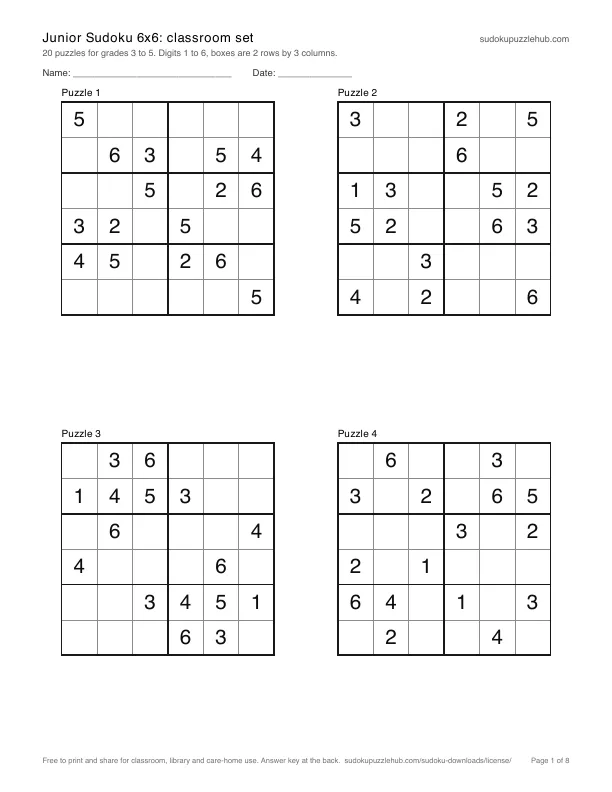
Once a class has 4x4 down, 6x6 is the natural next step: more digits to track, a slightly bigger grid, and one small new idea in the shape of the boxes. This set has 20 puzzles, four to a sheet, with a Name and Date line and the answer key at the back.
Junior Sudoku 6x6: classroom set
20 puzzles for grades 3 to 5. Digits 1 to 6, boxes are 2 rows by 3 columns.
Free to print and share for classroom, library and care-home use. Read the one-paragraph licence.
Why 6x6 is the right middle step
Jumping straight from 4x4 to the full 9x9 grid is a big leap: more than twice the digits and boxes that are genuinely harder to scan. A 6x6 grid adds only two more digits to track, 1 through 6 instead of 1 through 4, while keeping a puzzle short enough to finish in one sitting. It is a natural bridge rather than a detour.
Teaching the 2 by 3 box
The one genuinely new idea in this set is the box shape: two rows by three columns, rather than the square boxes of 4x4 and 9x9. Point it out directly before the first puzzle, tracing one box with a finger on the board. Children who have only seen square boxes often check the wrong six cells the first time, so a thirty-second warning saves a few minutes of confusion later.
After the set
Move up to the easy 9x9 set once 6x6 feels comfortable, or try the guided first puzzle online for a child who wants the full grid explained step by step before trying one alone.
Frequently asked questions
Grades 3 to 5, roughly ages 8 to 11, once the core no-repeat rule is already familiar from a smaller grid.
Twenty, printed four to a sheet, with the answer key at the back of the PDF.
Six does not divide evenly into a square box the way four and nine do, so a 6x6 grid uses 2 by 3 boxes instead. The rule inside each box is exactly the same.
They can, but the 4x4 starter set is the gentler first step. A child who has already solved a few 4x4 puzzles will find the jump to 6x6 straightforward within a sheet or two.